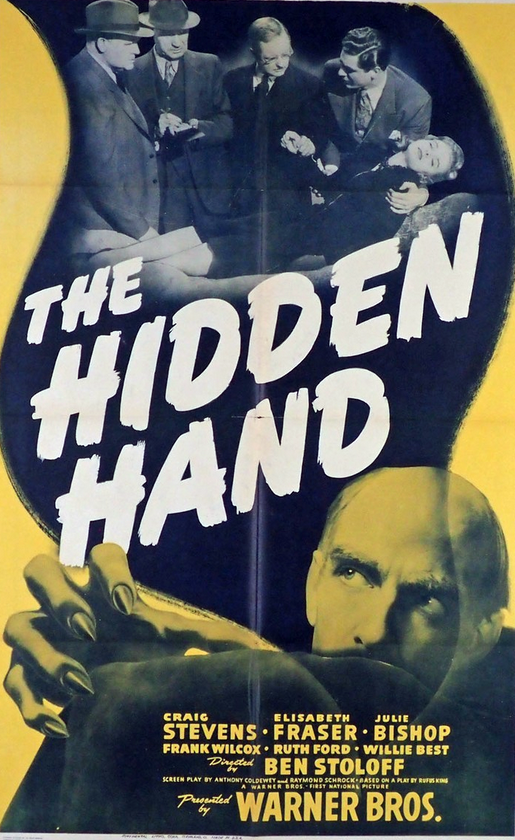
 The Hidden Hand is a 1942 American comedy-horror mystery about greed, inheritance plots, and a very unusual scheme involving an escaped mental patient.
The film was based on the 1934 stage play Invitation to a Murder, which starred Gale Sondergaard as Lorina Channing and Humphrey Bogart as Horatio Channing. In 1936, Warner Bros. announced plans to produce a screen adaptation and even intended to have Sondergaard reprise her stage role. However, that project ultimately fell through and was never brought to the screen.
Plot Overview:
Eccentric wealthy matriarch Lorinda Channing is surrounded by greedy relatives eager to get their hands on her fortune. To manipulate events and keep her money away from them, she secretly helps her unstable brother John Channing escape from an insane asylum. Lorinda disguises John as the household butler, and under her direction he begins to terrorize and dispose of relatives in mysterious and often grisly ways.
Meanwhile, young attorney Peter Thorne and Lorinda’s secretary Mary Winfield who are romantically involved, grow suspicious as the body count rises. They work to uncover the truth, stop John’s rampage, and prevent further deaths — all while trying to unravel Lorinda’s strange scheme.
The story mixes elements of old-dark-house mystery with dark humor, secret passages, and suspense as the characters navigate hidden motives, shifting alliances, and the chaos surrounding the inheritance plot.
CAST
- Craig Stevens as Peter Thorne — the young attorney and romantic lead (Stevens was known for roles in noir and adventure films, later starring in the TV series Peter Gunn).
- Elisabeth Fraser as Mary Winfield— the spirited female lead, often involved in investigating the goings-on.
- Julie Bishop in a supporting role (she appeared in many Warner Bros. pictures of the period). Julie is the mother of character actress Pamela (Sue) Shoop who some might recall as portraying Karen in Halloween II.
- Cecil Cunningham as Lorinda Channing — the scheming matriarch.
- Milton Parsons as John Channing — the creepy, asylum-escaped brother; Parsons was a character actor frequently cast in eerie, sinister roles.
- Willie Best in a supporting part (Best was a prominent African American comedian/actor in 1930s–1940s films, though his role here reflects the era’s stereotypical portrayals, which modern viewers often criticize as racially insensitive or “institutionalized racism”).
- Other notables include Frank Wilcox, Ruth Ford, and Roland Drew in smaller roles.
You might be able to find this on YouTube as it supposedly is a public domain film.
 grapleslife.org