
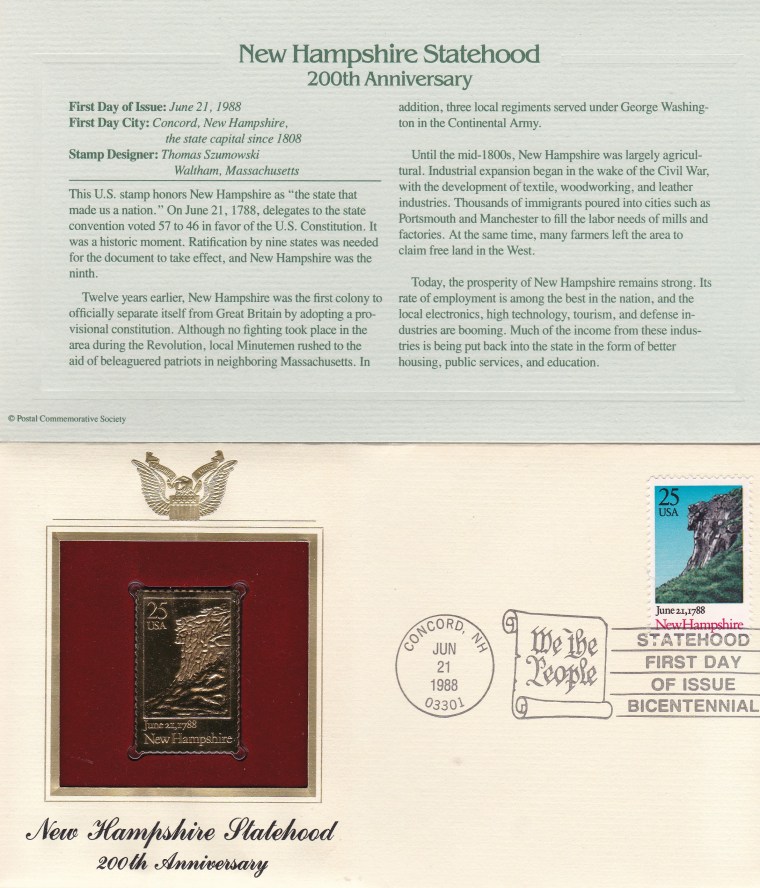
 This is a first-day cover featuring the New Hampshire commemorative stamp released in 1988 to mark New Hampshire’s 200th anniversary. The stamp depicts the Old Man of the Mountain, a natural rock formation that no longer exists, having collapsed from Cannon Mountain in 2003.
The Old Man was first documented by European settlers in 1805, and two different stories are commonly told about its discovery. One version credits Luke Brooks and Francis Whitcomb, who were working on a road between Peeling (now Woodstock) and Franconia. While resting at the lake at the base of the mountain, the men looked up and noticed what would later be called the Great Stone Face.
Another account attributes the discovery to Nathaniel Hall, who, along with a group of men, was also working on the road—then known as Notch Road. After camping overnight near the lake, Hall rose early to hunt partridge for breakfast. Pausing at the water’s edge, he looked up and saw the profile high above him. So struck by the sight, he reportedly abandoned the hunt altogether and rushed back to camp to tell the others what he had seen.
The Old Man was formed from five distinct layers of granite, stood approximately 40 feet tall (some sources say closer to 48 feet), measured about 25 feet wide, and rose 1,200 feet above Profile Lake. Over time, it became one of New Hampshire’s most beloved symbols and even inspired Nathaniel Hawthorne, who began writing The Great Stone Face in 1840. He completed the story in 1848, and it was published in 1850 in the January edition of The National Era.
While it’s undeniably sad that the Old Man of the Mountain is no longer there, there’s a certain comfort in believing that whatever it was watching and waiting for has finally come to pass—and that, at last, its spirit has been set free.
 grapleslife.org